




Customize this kit to meet your needs.
We'll adjust the parts list to match your energy usage, site conditions, and product preferences.

Questions? We’re Here to Help.
Get timely, human assistance from people with real-world experience. No question is too large or too small - reach out to us for guidance.
We're open M-F, 6am-4pm PST. After-hours messages get a response within 1 business day.
Description
About the Enphase IQ8HC DIY solar kit
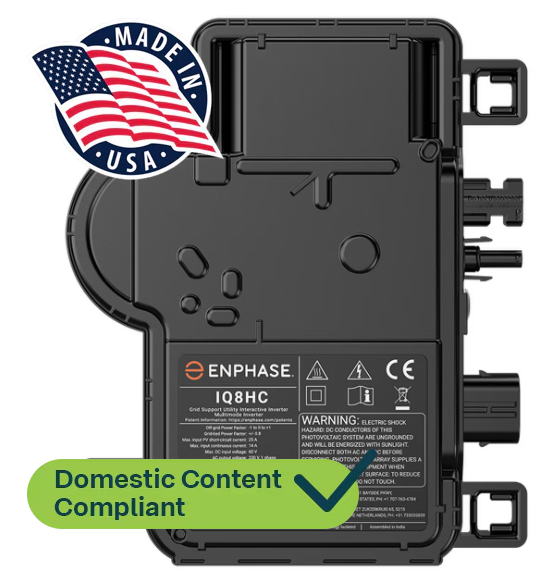
Reduce or completely eliminate your electric bills with SolarTown's Enphase IQ8HC DIY solar kit, a complete grid-tied solar package built around Enphase IQ8HC microinverters and high-efficiency monocrystalline solar panels.
Microinverter-based solar kits are ideal for sites where trees, chimneys, or other obstructions cast shadows on your roof at least part of the day. Unlike string inverter systems, where shade on one panel drags down production across the entire array, microinverters isolate each panel so the rest of your system keeps producing at full capacity.
Default kit configurations range from 4.5 kW to 13.5 kW. Need something different for your project? Reach out to us - we design custom kits too. Every component is sized for compatibility and selected to comply with permitting regulations and building codes, which matters when you're pulling your own permit.
Enphase IQ8HC Micro-inverters: Made in the Shade
In a string inverter system, panels are wired together in groups that share electrical characteristics. When shade falls on one panel in the string, it pulls down production for every panel connected to it. The more shade exposure your roof gets (from trees, a chimney, or a neighboring roofline) the more output you're leaving on the table.
Microinverters solve this by giving each panel its own independent inverter. The Enphase IQ8HC works to isolate the production of each solar cell in a panel. When shade hits the corner of a panel, that region will still be affected, but the rest of the panel (and the array) still produces power like normal.
If your site has any shading at all - even seasonally, when sun angles change and shadows from obstacles grow longer - the IQ8HC microinverters will recover production that a string system would normally lose.
Flexible & Expandable
Your energy needs change. This system is designed to grow with them.
Because each panel is paired with its own dedicated microinverter, expanding capacity is straightforward: add a new panel and inverter pairing and you're done. No redesigning the original system, no replacing a central inverter to handle higher input.
Enphase equipment is also designed to work regardless of application. If you decide to add battery backup down the road, your existing IQ8HC microinverters and combiner are already compatible with Enphase battery storage. There’s no need to swap out hardware when your priorities shift. Simply hook in the battery bank for backup power, should you decide you need it down the road.
Installing this kit
Our kits ship directly to your home or business address, ready for installation. You can handle the install yourself, or hire a local electrician or solar installer to help out - it’s up to you.
The main reason most customers choose the DIY option is cost savings. A full-scale turnkey installation typically runs about twice what you'd spend sourcing the equipment and doing the work yourself. If you’re interested in the savings, but aren't sure where to start, SolarTown's DIY solar resource center has in-depth guides covering every phase of a solar project, from design through commissioning.
For DIY installs, SolarTown's permit package simplifies the process of filing your own permit. We'll provide the documentation your jurisdiction needs to review and approve your system, including spec sheets, line diagrams and engineering calculations.
If you hit a wall, reach out to us. You'll have a direct line to real technicians with hands-on solar experience who can help you navigate through your issue. We don’t just ship you a kit and leave you to your own devices: our phone support line is available for help before, during, and after the DIY installation process is finished.
What's included in this kit?
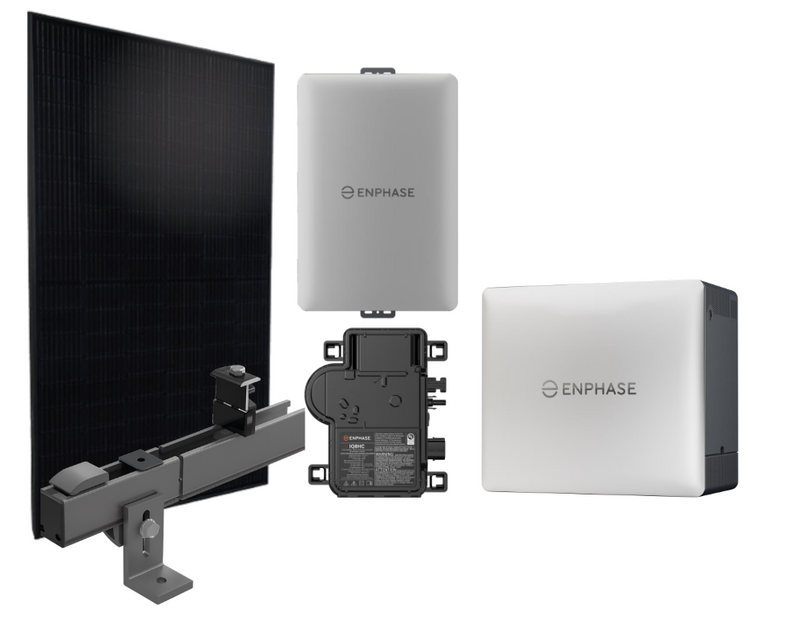
- High-efficiency Tier-1 monocrystalline solar panels (~440W+ each; quantity varies by kit size)
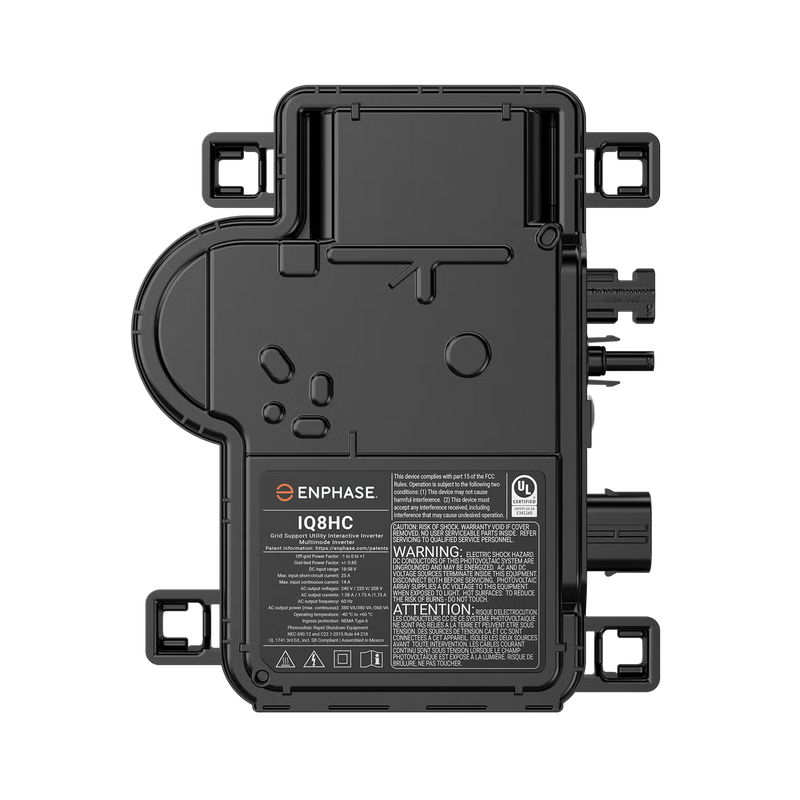
- Enphase IQ8HC microinverters (CEC compliant; rapid shutdown ready)
- Enphase IQ Combiner 5 with IQ Gateway PCBA and pre-installed hold-down kit
- Tamarack flush-mount racking (rails, mid/end clamps, L-feet)
- Tamarack Multimount Flashing – Rafter w/ Lag Bolts (8-Pack) for watertight rail attachment
- AC trunk cables, end caps, and required wiring accessories
- Permit-ready spec sheets
- Installation manual and setup support resources
- Optional add on: Permit Plan Set
Who Is This Kit For?
- Anyone who wants to: reduce electric bills and maximize savings
- Made for homes and businesses connected to the electric grid
- DIYers who need a permit-ready, policy-compliant kit for easy installation
- Contractors, electricians, and homebuilders offering residential installs
Key Benefits
- Permit-ready package helps pass inspection the first time
- CEC compliant and designed for PG&E NEM 3.0
- AC-coupled with full Enphase Enlighten monitoring
- Battery-ready: add storage anytime
- Backed by SolarTown support
Enphase IQ8HC Solar Kit FAQs
Grid-tied systems (like this one) are designed primarily to cut electricity costs. The lack of a battery bank keeps up-front costs low, maximizing electric bill savings over the life of the system. It’s a long-term investment: over the 25+ year life of the warranty, generating electricity from solar panels is almost always cheaper than buying power from the utility.
"Net metering" allows you to store energy produced by your solar panels in the utility grid, then use it any time you need it, eliminating the need for local battery bank storage.
A net metering contract outlines the terms of the agreement, which works like a bank account: you deposit solar energy into the grid. The utility keeps a balance of credits for the power you generate. You withdraw credits from that balance when you use electricity to power your appliances. Net usage (power generated minus power used) is tracked by a meter on your property, hence the term "net metering."
Micro-inverters are smaller inverter units that attach to each individual solar panel in a system. Each micro-inverter is paired with its own solar panel, offering greater shade mitigation than string inverter systems. When shade falls on a panel, micro-inverters isolate the affected area so that the rest of the array (still in full sunlight) continues to produce power, unaffected by the obstruction.
For properties where trees, chimneys, or other obstructions may block part of the solar array, micro-inverters will recapture some of the production that would have been lost in string inverter systems.
No. Since grid-tied systems store power in the utility grid, your power goes out when the grid goes down. The good news is that Enphase systems use the same components regardless of whether or not they’re plugged into the grid. A battery backup configuration of this kit is available with the battery bank included.
Yes! Most solar equipment is designed to be compatible for a single application, but Enphase’s core components are built to work with or without the grid. You can start by building a grid-tie system now, then add batteries later as budget allows (or as needs change). Compatible battery banks will work seamlessly with the Enphase IQ8HCs and combiner box - no equipment swaps needed.
Yes - micro-inverter systems are easily expandable. Because each panel pairs with its own inverter unit, expanding the system is as simple as adding a new pairing (or pairings) of panel+inverter to the chain. Unlike string inverter systems, your solar array won’t need to be re-wired to balance the electrical characteristics evenly between strings. You can simply add as many new panels as is necessary to provide the extra capacity needed.
Installing solar panels is not trivial, but it's well within reach for most people who are comfortable with basic physical work and willing to follow detailed instructions. Panels weigh up to 50 pounds, and need to be hoisted for rooftop installs. Metal footings are screwed into a solid foundation (either roof rafters or a dedicated ground mount), racking rails are attached, and panels are mounted onto the rails. Some basic plug-and-play cabling is required between panels and inverters.
The entire system can be built by a competent DIYer. Most people who DIY install need only hire a licensed electrician for the final electrical panel hookup (which may be required in some jurisdictions).
Different jurisdictions have different requirements, but some common inclusions in a permit application are:
Spec sheets: complete technical specs for every major component in your system
Electrical line diagrams: Single-line and three-line diagrams showing how electricity flows through your system. Must include wire sizing, breaker ratings, and all connection points.
Site plan: Overhead property view showing exact panel placement, including clearances from roof edges, obstructions, property line setback requirements, and fire access pathways.
Load calculations: Engineering calculations proving your roof or ground mount can handle equipment weight, wind loads, and snow loads specific to your climate zone.
Our Residential Permit Plan Set addon package includes all necessary documentation required to file for a permit, with free adjustments and revisions available to comply with your local jurisdiction's standards.
System Components
Enphase IQ8HC Solar Kit Components
- High-efficiency Tier-1 monocrystalline solar panels (~440W+ each; quantity varies by kit size)
- Enphase IQ8HC microinverters (CEC compliant; rapid shutdown ready)
- Enphase IQ Combiner 5 with IQ Gateway PCBA and pre-installed hold-down kit
- Tamarack flush-mount racking (rails, mid/end clamps, L-feet)
- Tamarack Multimount Flashing – Rafter w/ Lag Bolts (8-Pack) for watertight rail attachment
- AC trunk cables, end caps, and required wiring accessories
- Permit-ready spec sheets
- Installation manual and setup support resources
- Optional add on: Permit Plan Set
Warranty
Enphase IQ8HC Solar Kit Warranty Information
- Solar Panels: Manufacturer Output Warranty 25 years, Manufacturer Material & Workmanship 5 years
- Enphase IQ8HC Microinverters: 25-Year Limited Warranty
- Enphase IQ Combiner: 5-Year Warranty
- Tamarack Mount System: 25-Year Warranty
Documentation

Specifications
Enphase IQ8HC Specifications
Input Data (DC)
| Parameter | Value |
|---|---|
| Commonly used module pairings1 | 320–540 W |
| MPPT voltage range | 29.5–45 V |
| Operating range | 18–58 V |
| Minimum / Maximum start voltage | 22 / 58 V |
| Max. input DC voltage | 60 V |
| Max. continuous operating DC current | 14 A |
| Max. input DC short-circuit current | 25 A |
| Max. module Isc | 20 A |
| Overvoltage class — DC port | II |
| DC port backfeed current | 0 mA |
| PV array configuration | Ungrounded array; no additional DC side protection required; AC side protection requires max 20 A per branch circuit |
Output Data (AC)
| Parameter | Value @240 VAC |
|---|---|
| Peak output power | 384 VA |
| Max. continuous output power | 380 VA |
| Nominal grid voltage (L-L) | 240 V, split-phase (L-L), 180° |
| Minimum and maximum grid voltage2 | 211–264 V |
| Max. continuous output current | 1.58 A |
| Nominal frequency | 60 Hz |
| Extended frequency range | 47–68 Hz |
| AC short circuit fault current over three cycles | 2.70 Arms |
| Max. units per 20 A (L-L) branch circuit3 | 10 |
| Total harmonic distortion | <5% |
| Overvoltage class — AC port | III |
| AC port backfeed current | 18 mA |
| Power factor setting | 1.0 |
| Grid-tied power factor (adjustable) | 0.85 leading...0.85 lagging |
| Peak efficiency | 97.31% |
| CEC weighted efficiency | 97.00% |
| Nighttime power consumption | 22 mW |
Mechanical Data
| Parameter | Value |
|---|---|
| Ambient temperature range | -40°C to 65°C (-40°F to 149°F) |
| Relative humidity range | 4% to 100% (condensing) |
| DC connector type | Stäubli MC4 |
| Dimensions (H × W × D); Weight | 212 mm (8.3") × 175 mm (6.9") × 30.2 mm (1.2"); 1.1 kg (2.43 lbs) |
| Cooling | Natural convection — no fans |
| Approved for wet locations; Pollution degree | Yes; PD3 |
| Enclosure | Class II double-insulated, corrosion-resistant polymeric enclosure |
| Environmental category; UV exposure rating | NEMA Type 6; outdoor |
Compliance
| Parameter | Details |
|---|---|
| Certifications | CA Rule 21 (UL 1741-SA), UL 62109-1, IEEE 1547:2018 (UL 1741-SB), FCC Part 15 Class B, ICES-0003 Class B, CAN/CSA-C22.2 NO. 107.1-01 |
| Rapid shutdown | UL Listed as PV rapid shutdown equipment. Conforms with NEC 2014, NEC 2017, NEC 2020 section 690.12 and C22.1-2018 Rule 64-218 when installed per manufacturer's instructions. |
- No enforced DC/AC ratio. See the compatibility calculator at enphase.com/installers/microinverters/calculator.
- Nominal voltage range can be extended beyond nominal if required by the utility.
- Limits may vary. Refer to local requirements to define the number of microinverters per branch in your area.
Related Products
Related Products
Enphase
SolarTown


Sol-Ark
Enphase
Enphase