
ROI of solar: how much money can I save going solar?
ROI of solar: how much money can I save going solar?
25-Year Energy Savings with Solar (vs. Grid Power)
Based on US national average energy cost and household energy consumption rates
One of the strongest arguments for going solar is the amount of money it can save you on electric bills over the life of the system.
On average, solar panels pay for themselves in 5-10 years, depending on a variety of factors like installation costs, local climate, and available tax credits.
Since most systems last 25+ years, this means that the great majority of solar homeowners profit from their investment by generating at least 15 years of free energy after their system is paid off.
This article will help you get a sense of the costs, payback period, and expected return on your investment into solar.
We’ll also cover considerations for off-grid properties, outlining how solar stacks up to other methods of delivering power to remote properties.
Grid-Tie Solar: Costs & ROI
Grid-tie solar is the ideal choice for you if all of the following things apply:
- You own your property (not rented/leased)
- You are connected to the utility grid
- Your primary goal is to reduce or eliminate electric bills
In grid-tie systems, the electricity generated by solar panels feeds into the utility grid, where it is stored for later use. System owners receive a credit for any energy they generate, which can then be used to power their household appliances.
If cutting electricity costs is your primary goal, grid-tie solar is your best bet because it eliminates the need to buy a battery bank to store energy on-site. Batteries are expensive. Skipping them dramatically accelerates your payback period and helps you get the most out of your investment.
The key downside is that grid-tie solar systems are still vulnerable to power outages. Since you’re still pulling electricity from the grid, you’ll be left in the dark if it goes down.
If you live in an area with unreliable grid power or severe weather events, we’d recommend our hybrid solar kits, which add battery backup to grid-tie systems. Their primary focus is to reduce electricity costs, but add a small backup battery bank for protection during short-term outages.
Cost Breakdown: How Much Does It Cost to Go Solar?
Let’s get into the numbers. First, a few benchmarks based on national averages in America:
- According to recent research by NREL, full-service solar installations cost $2.70/watt
- DIYers can save approximately 50% of these costs by self-installing
- The typical American home uses around 10,000 watts per year
- This usage would require ~6.5 kW (or 6,500 watts) of solar to offset
Based on these figures, you can take a look at your electric bill to see how much solar you would need to cover your energy usage.
From there, take a look at our grid-tied solar kits for updated pricing on solar components. Our kits ship on a pallet and are designed to be installed by DIYers and contractors. If you plan to hire a professional installer, one way to get a very rough estimate of costs is to research kit pricing on our storefront, then double its cost to account for the installer’s overhead.
Hidden Costs: Replacement Parts
While solar panels last for 25+ years, other parts of the system may have shorter warranties. Part replacements should be included in the cost calculations where appropriate. Specifically, string inverters and batteries will likely call for 1-2 replacements over the life of the system.
See our article on the lifespan of solar components for details.
Solar Payback Period: How Long Will It Take to Offset the Initial Investment?
Your payback period depends on the cost of electricity from your local utility. Higher electricity costs translate to faster payback periods. The more money you save on electric bills each month, the sooner you’ll break even.
Here is the formula for calculating solar payback period:
(Cost - Incentives) / Cost of Electricity / Annual Usage = Payback Period
A sample calculation, based on national averages:
- 6.5 kW Enphase IQ8 micro-inverter kit: approx. $14,000 (includes estimate for taxes, shipping and permitting fees)
- 30% back from the federal solar tax credit (discontinued after 12/31/2025)
- $0.1522/kWh electricity costs
- 10,000 annual kWh usage
The results:
($14,000 - $4,200) / $0.1522 / 10,000 = 6.44 years
Under these assumptions, a self-installed solar system will pay for itself in around 6 and a half years. Full-service installations, at approximately double the cost, extend the payback period to around 13 years.
Either way, solar clears the break-even point less than halfway through the life of the system, giving owners years of free energy from their panels.
Return on Investment (ROI): Calculating Total Lifetime Energy Savings
This calculation can be extended to figure out how much you can profit in the form of energy savings over the life of the system.
Take your payback period from the previous step and subtract it from the expected lifespan of your solar panels under warranty (usually 25-30+ years). Then, multiply by the cost of electricity and annual usage to figure out your expected return on investment.
- DIY: 25 - 6.44 = 18.56 years x $0.1522 x 10,000 kWh = $28,248.32
- Full install: 25 - 12.88 years x $0.1522 x 10,000 kWh = $18,446.64
25-Year Energy Savings with Solar (vs. Grid Power)
Based on US national average energy cost and household energy consumption rates
In this example, the typical DIYer stands to save more than $28k in energy bills, while full service installs might return a yield of around $18.5k.
One more note: these benchmark figures don’t take into account more complex factors like the forces of inflation or the rising costs of electricity. That’s a little beyond the scope of this article, which is designed to help people with the “napkin math” of going solar.
But it’s worth pointing out that these factors make the case for solar even stronger. Locking in your means of energy production will protect against rising costs in the future.
Off-Grid Solar Cost & ROI
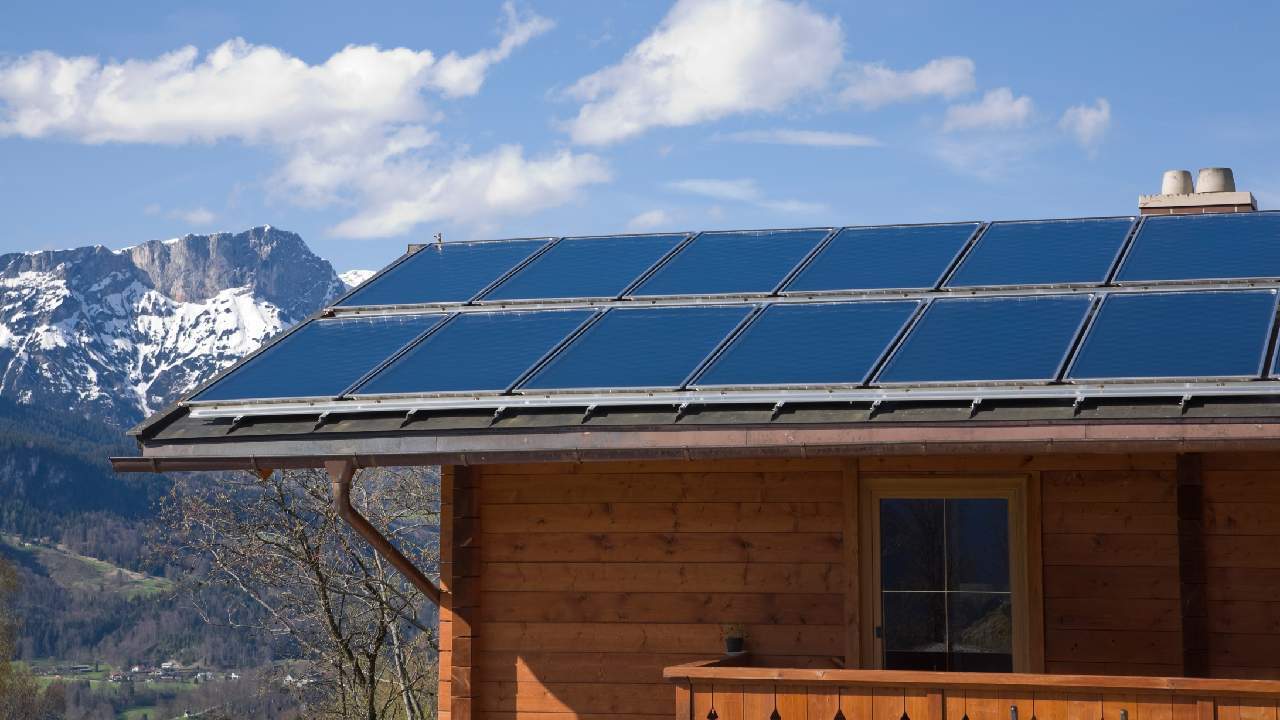
We just compared solar to the cost of pulling electricity from the utility. But what if you don’t have access to the grid?
For off-grid properties, the considerations change. It doesn’t make sense to weigh the cost of solar against grid power, because no grid access is available. Instead, you should evaluate it in comparison to other methods of delivering power to your site, like running new power lines or operating gas generators.
Cost Benchmark: Off-Grid Solar
Off-grid solar is more expensive than grid-tied solar, due to the need for batteries to store energy locally on site. However, in most cases, it still works out to be a more cost-effective option than the other methods mentioned. Compare the cost of our off-grid solar kits to alternative options to determine works best in your situation.
Cost Benchmark: Diesel & Gas Generators
Generators are another popular pick for off-grid properties. Most people build some mix of solar and diesel generators to meet their needs.
Solar is most effective in regions with consistent exposure to sunlight. While off-grid solar systems can store some energy locally, their capacity is limited to keep battery bank costs under control.
Off-grid battery banks are sized to provide a few days of autonomy, so that appliances can pull from your battery bank when bad weather is preventing your panels from generating any energy.
In harsh climates, it’s unrealistic to live off your battery bank for days or weeks at a time. That’s where generators come in. On-site fuel tanks are essential to spell the periods when your panels can’t get any sunlight. Your solar system and generators should work in tandem to provide a layer of redundancy and keep the lights on at all times.
Diesel generators cost approximately $0.50 to $1 per kWh to run - about 5-10x the operating cost of off-grid solar on average. They’re also noisy, have shorter warranties (easier to run into the ground), and require regular maintenance.
For these reasons, generators should be treated as a backup option for your batteries, only to be used when necessary. If your solar system is properly sized, you should only need to top up your generator bank 2-3 times a year.
Edge Cases: Wind, Hydro, Power Lines
These options are worth mentioning because they may be the best option for folks under ideal circumstances. However, they are edge cases that won’t be right for most off-grid projects.
Power lines
Very short (sub-500 foot) power line runs may be feasible, but it’s usually way too expensive. You might pay $10,000+ to run a 500-foot power line, and the cost only scales up with distance from the grid. Beyond that, you still need to pay for utility power once it’s set up.
Hydro power
If you have year-round access to a stream or river with a strong enough current, hydro power may be worth a look. Its cost can rival off-grid solar at around $0.06 to $0.10 per kWh, with high-performing sites pushing closer to $0.02 per kWh in great conditions.
It’s rare that residential properties have all the conditions to make hydro worthwhile. Not only do you need a body of water with strong flow, you also need a significant elevation change to create a waterfall strong enough to spin a water wheel. However, if these conditions can be met, hydro can be a viable option.
Wind power
Similar to hydro power, windmills require optimal conditions to match the output of solar. They’re best suited in places that promote high wind speeds:
- wide-open spaces
- high elevations
- tight gaps between mountains that funnel winds
- smooth terrain - few trees / rocks blocking winds
Wind power has traditionally been better suited for commercial and utility-scale projects. However, it may have some residential applications if most or all of the above conditions apply.
Free Download: DIY Solar Planning Toolkit
DIY solar has a lot of moving parts: complex permitting applications, unexpected roadblocks, and complex ROI calculations that account for hidden costs and changing utility rate structures. We've compiled everything into one workbook so you can track it all in one place.